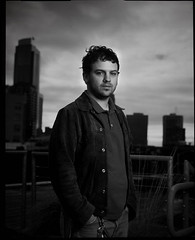
With
strokes of his upbringing, faith, experiences and relationships, Andrew
Peterson creates art. Like an intricate oil painting, the nuances,
layers and textures combine to create something distinct and deep. But
to Andrew, it’s just part of the process… down to the very DNA of the
lyrics.
John: So tell me a little about Andrew Peterson. Where are you from, what’s your family look like?
Andrew Peterson:
I’ve been married 17 years and have 3 kids who are 13, 12 and 9. I was
born in Illinois (basically in a corn field), then when I was 7 we moved
to what I lovingly call “redneck Florida.” So I went from having a sort
of golden-boy-Midwestern childhood to [the] deep south, ya know? [With]
all of the good and bad and wonderful things that come with a southern
childhood. My dad is a pastor and he still preaches at the same town
that I grew up in north Florida. I ended up randomly going to Bible
college. Not for any noble reason, mainly because it was affordable and I
couldn’t think of anything else to do (laughs). So I went to Bible
college and fell in love with it almost immediately. I met my wife
there, got a Bible degree, put out an indie record then moved to
Nashville where I’ve been making records ever since.
John: Which Bible college?
Andrew:
It was called Florida Christian College in Kissimmee/Orlando. Just a
small, really conservative Bible college within my “non-denominational
denomination.” (laughs)
John: (Laughs) You may be the first person who has publicly made that into an official denomination…
Andrew: I coined it! Yes!
John: Would you consider Florida to be southern living?
Andrew:
Oh yes, at least the part of Florida that I lived in. Florida is a
funny place. I maintain that it is the weirdest state in the United
States – and I mean that in a good way. I didn’t like it when I was a
kid, but now that I’m a writer and part of my life involves telling
stories, I feel like I could not have grown up in a richer story-telling
culture than Florida. It’s this kind of strange convergence of beach
culture and retired people and snowbirds and Cuban-Puerto Rican culture.
If you drive about 15 minutes inland from the beach or out of any town,
you’re in this swampy, unique kind of country, [with] racism and
southern hospitality and Bible belt stuff and it’s just a really
fascinating place. I’ve gotten to [this place that] now that I’m older,
I’ve started reading books by southern authors because I’m so fascinated
by the cultures there. Everybody from Flannery O’Connor to Marjorie
Kinnan Rawlings and people like that. And so I’m really grateful. I
never want it to sound like I’m talking bad about my home state but it
is bizarre and I’m just delighted by that.
John: Do people in north Florida eat grits or biscuits and gravy?
Andrew:
Oh yes, as often as possible. My little town is called Lake Butler and
it has three generations of family sheriffs. There’s a railroad track
and the white people lived on one side and the black people lived on the
other. There was a poured house and a little drug store where farmers
in overalls would talk in the heat of the day and my dad is a southern
preacher which means that he paces a lot and occasionally little flecks
of spittle. It was exactly what you would imagine a “deep south
childhood” would look like. So yeah, I think that may be part of where
my love for storytelling came from. All you have to do is sit on the
porch for a few minutes and eavesdrop on my dad’s conversations and you
hear the most colorful, beautiful language – good stories. It’s a farm
culture and yeah, I couldn’t wait to escape it when I was a boy, but now
that I’m a grown up I live in a metropolitan area and the older I get
the more I’ve started calling my mom and dad and asking them how to grow
tomatoes and how to keep the deer out of the pumpkin patch (that sort
of thing), and so yeah, I feel like it’s a part of who I am.
John: Did you meet Rich Mullins?
Andrew:
I did. Just 2 or 3 times, and each time it was in a really
unadulterated fan context. I shook his hand and told him I loved him and
passed him a demo. That kind of thing. It’s funny, I had just finished
recording my independent record in college. I was 22.
John: Was that The Walk?
Andrew:
Yeah, and it’s terrible. When I go back and listen to it, I can hardly
listen to it because it’s so bad in so many ways. But at the time, when
you’re 22 you feel like you’re the king of the world and I thought “Man,
I’m going to give this CD to Rich Mullins and he’s going to love it and
we’re going to become friends!” But he died a year later so I never had
a chance to live down how bad the demo was. I later became friends with
Mitch McVicker who was friends with Rich’s touring partner back at the
time and I was always really self-conscious that I had met them both at
this geeky fan phase so I didn’t let on that I’d already met Mitch
before. Years later when we started doing shows together I was like
“man, do you know that we met before we started traveling together?” and
he was like “oh yeah, I remember, it was at your college in Florida”
and I was horrified! I said “Ahhh! No! You don’t by chance remember that
I gave you a demo CD do you? And he said “yeah”, so I said, “you guys
didn’t ever hear it did you? And he goes “yeah… we hated it.” (laughs)
So I thought that was delightful. There’s a part of me that’s like maybe
it’s a small mercy that I didn’t meet Rich because it would have been
the worst thing to find out that he couldn’t stand me, ya know? (laughs)
[This way] I can pretend that maybe we would have been friends.
John: You’ve carried the storytelling trait from your dad, which Rich had too. Was that something unique in his music that drew you?
Andrew:
Yes, definitely. I’ve kind of jokingly said that Rich’s music rescued
me from Lynyrd Skynyrd. I was in a rock band the year after high school,
touring around, but it never ever would have crossed my mind that I
wanted to do Christian music because I grew up in this goofy paradigm
that meant being in the ministry meant being a pastor, or a missionary.
And I didn’t want to be either of those things so I just thought, well, I
guess I don’t want to be in the ministry. So hearing Rich’s music
around that time opened my eyes to how powerful a song can be. C.S.
Lewis described stories this way, he said that stories could “sneak past
peoples’ watchful dragons.” The idea is that a sermon will hit you
head-on but art can flank you, surprise you and flip truth behind your
lines when you least expect it. I think that’s what happened with Rich’s
music and me. I wasn’t terribly interested in the Gospel. Ya know, I
would have told you that I was a Christian but I was really struggling
and really trying to find my way and then I heard this Rich Mullins song
that captivated me with its poetry and the roughness that I heard in
his voice. He was a smoker – I didn’t know it at the time – but I heard
something broken in his voice. Emotionally and physically
for that matter. So that brokenness was more beautiful to me than any
of the slick stuff I had heard in Christian music. And it really drew me
in. What I heard was loneliness and some sadness and a deep longing,
and all of that resonated with me. I felt like he was singing the way my
heart felt.
It was because he was willing to be honest about his own struggle and
the truth about Who Jesus really is. That woke-up something in me. It
took all of those Bible stories that I had grown up with over the years
and my love for The Lord of the Rings
and adventure stories and all of those things converged in the songs of
Rich Mullins and I found something that I’d never found before. So ever
since then, every time I sit down to write a song, I’m trying to get
close to the feet of those mountains. If I can write something like “The
Color Green” by Rich Mullins or “Copperline” by James Taylor or
“Graceland” by Paul Simon I think it’s good for a songwriter to keep
listening to the masters. To ask yourself “well how in the world did
they write songs that move me like this?” Every time you sit down you’re
probably going to fail but you gotta at least try, ya know? So I’m
always trying to get back to the way that I felt sitting on the side of a
mountain in east Tennessee and listening to Rich Mullins music. So
that’s what I’m shooting for, whether or not I ever attain it.
John: So then you met Derek Webb… or he found you? How did that work?
Andrew:
(laughs) That was back when the internet was relatively new and I was
waiting tables at the Olive Garden here in Nashville. We had just moved
here. Jamie and I were childless, poor and working really hard. I
couldn’t get any bookings. One night I discovered this band, Caedmon’s
Call, and I really liked their music. I think I discovered them because
of their friendship with Rich Mullins. I think that’s how I ended up
finding their website. I ended up posting something online about how
their songwriting and music was really the first thing that had moved me
like that since I’d heard Rich Mullins’ music. I included a link to my
really lame website, and Derek followed the link and read my lyrics and
he really liked them. He saw something in them and I ended up meeting
them later at a concert and he remembered me and I said, can I open for
you guys? And he said yes. That was basically the beginning of my music
career. (laughs) I don’t know why he said yes, he’d never heard me play a
song before. Never heard what I sounded like live. But for whatever
reason, they happened to not have an opener like a week later so I got
to drive out to west Tennessee and play a show with them. A month later I
was on the tour bus.
John: Wow and now you’re getting ready to release your 12th or 13th album?
Andrew: Well if you included all of the little side projects [I’ve done] it would be about that many, but it’s either the 8th or 9th full-length studio record, I can’t remember.
John: Ok, before talk about the new album, let’s talk a second about this “Square Peg Alliance” group you created. What is it?
Andrew:
Well, it’s funny, The Square Peg Alliance is not as active as it was
maybe 3 or 4 years ago. Basically, I didn’t start it – it was just
something that grew sort of organically at our little songwriting
community here in Nashville. In reaction to how a lot of us had been on
Christian record labels, some of us had had radio play and then as the
industry started to change we all found ourselves not “pop-Christian”
enough to get by in the Christian world and “too Christian-y” to ever
have a chance to get by in the mainstream world. And so we didn’t know
what to do other than lock arms with each other and just try to help
each other survive and stick to the calling of the type of songs we were
writing. We kinda jokingly named ourselves the Square Peg Alliance. Ya
know, all we did was give a name to this thing that was already
happening. The same thing is still happening, we just don’t officially
gather under that name anymore.
John: Did the Rabbit Room kind of morph out of that?
Andrew:
The Rabbit Room didn’t morph out of it, but it came for the same love
for community. Ya know, I went to England and saw the pub where Tolkien
and C.S. Lewis and Charles Williams and their buddies used to get
together and read their stories. And around that time I read a book
about the Pixar company and I started to recognize that really good art
thrives in the confines of community. We had some of that happening with
music already, but I was writing my books and I wanted to grow into a
better writer – and I knew a lot of people who wanted to do that same
thing. So The Rabbit Room was kind of an experiment in community. We
thought, what happens if we get some authors and pastors and songwriters
and artists all joined together with the hopes that we’ll learn to make
excellent work? And invite people into that conversation and see what
happens? So we didn’t really have a clear direction, I just bought the
domain name and made the website and invited some friends to be a part
of it, and that was about 5 years ago. It’s doing really well. It’s been
a pleasant surprise at almost every turn.
John: And so now you’ve written 3 books?
Andrew: I’m [currently] writing my 4th book.
John: Obviously you’re an artist, but do you have a preference between writing music or books? Is one easier for you?
Andrew:
Um, I think that the easier one is whichever one I’m not doing.
(laughs) Yeah, it’s all hard. There’s a part of me that really loves the
book making process. Part of that is because I can stay home, it
doesn’t involve a lot of travel, [it’s] a slowing down. It’s work, but
it isn’t frantic
work. Being on the road, playing music, there’s a lot of travel and
deadlines and craziness, whereas book writing is probably more diligent
work. It just doesn’t take me away from my wife and kids, so I really
love that. With that said, I’m supposed to be writing book 4 right now
but it’s been like trying to push-start a semi truck. Like I’ve had a
really hard time mustering the discipline to really dig into it, so ya
know, it’s all really hard, man. (laughs) It’s like planting the garden,
the only way to get good fruit is to sweat and bleed for it, so that’s
where I am right now.
John: But maybe that’s due to the fact that you have a new record coming out too…
Andrew:
Well, that’s part of it. I have been pretty busy with the record thing.
I feel a little bit creatively capped ya know, from writing the songs
probably too quickly. So that’s part of it. If I’m really honest with
myself I am also just trying to avoid it because it’s a lot of work.
(laughs) When I was in Bible college I wanted to be a youth minister
because I thought he was the one who did the least amount of work in the
church. (laughs) I did it for a year and realized that the opposite is
true. So I quit [youth ministry] thinking, well maybe I can get out of
doing work if I play music. And that wasn’t really true either.
John:
You’ve touched on various themes in your previous records… What is the
name of the new record, and is there an overarching theme?
Andrew: The name of the record is Light for the Lost Boy. And
if there was a theme (I think the title kind of sums it up), [it’s
that] a lot of the songs on this record are about growing up. There are a
lot of aspects to what it means to grow up. There’s the exit from Eden,
this aspect of childhood that we are all kind of exiled from as we sin
and grow old which creates this longing for restoration. There’s this
longing for Jesus to hurry up and come back, to let us enter this
Kingdom where we’ll have undying bodies [without] the pain of age or
wasting away. Ya know, the effects that occur. There’s a lot of longing
wrapped up in [this record]. I’m just trying to figure it out myself
too. I don’t know. I’m watching my kids teeter into adolescence and the
conversations with them have gotten more difficult. It’s not like we’re
having problems with them, [it’s just the] preparing them for the world
they’re growing into. It’s been pretty sad for me. I mean, I’m excited
because they’re amazing kids and I think they’re going to do great
things for the Kingdom, but at the same time, I’m grieving a little
because I know that part of the process, the discipline that we receive
as children of the King is sometimes painful. They’re going to make
mistakes. The older they’ve gotten the more I’ve remembered my own
childhood, ya know? I remember the sweetness of it, but I also
remembered some of the moments that have continued to cause me pain over
the years. So I’m guessing that’s why so many of the songs deal with
childhood and the longing for restoration. But honestly I don’t know.
I’m trying to be better about writing the songs I write and letting the
listener add his or her own DNA to the thing. Most of us have seen the
movie Jurassic Park, but I don’t know if you remember the scene where
they’re going through the ride and the little computer thing is
animating how they recreated dinosaurs from the DNA they found in the
mosquitoes. And it shows these cartoon DNA strands and they’re like,
well, we couldn’t really complete the DNA strands from the dinosaur so
we used some from a turtle (I think or maybe it was a lizard) to
complete the DNA and we created these dinosaurs. And I think songwriting
and art are like that. My songs are these strands of my own DNA but
there are all of these holes in them, like the songs aren’t a complete
story. So the listener then brings his own DNA to the song and it begins
to mean something specific to him or her. I remember that happened with
“Dancing in the Minefields” this song about my marriage. The first line
is “I was 19 and you were 21 the year we got engaged…” And I’ve gotten
so many emails from people who are like “your story is just like
my story, she was 19 and I was 21 the year we got married” and those
details aren’t right at all! (laughs) They got the numbers backwards and
they got the engagement and the wedding different because these people
have brought their own story to my song so much so that the details of
my song becomes irrelevant. So I’m hoping that with this record that
whatever I meant by it will only be the beginning of the story for what
the songs do in the heart of the people who are hearing it.
John: What music are you enjoying lately?
Andrew:
I have been listening to a lot of the new Bon Iver record a lot. As soon
as I said that I remembered there’s a bad word in one of the songs.
There’s a band called Fleet Foxes that my sons and I really like. It’s
really creative, almost classical sounding folk music, “chamber folk” is
what some people call it I think. And then there’s this new Ben Shive
record, he’s the guy who produced my new album – he’s really great.
There’s this guy Josh Garrels, he’s great. We’ve connected and I tried
to talk him into the Christmas tour this year. His wife is going to have
a baby right before the tour so he couldn’t do it, but I’m a huge fan
of his. Josh makes me feel the way I felt when I listened to Rich
Mullins, I think Jon Foreman (of Switchfoot) is like that too. There are
very few people who have such great music that is so unabashedly about
the gospel. I think Josh is one of those guys. Man, when I’m jogging and
I hear his music, sometimes I “ugly cry.” (laughs) He’s so explicit
about the God that he’s singing to and about. I’m deeply moved by that.
So there’s a short list.
John: What kind of dog is your pet, Moon Dog?
Andrew:
(laughs) He is a Great Pyrenees. He’s a white, bushy, sheep-herding
kind of dog. That’s Moon Dog. He’s white so he’s easy to see when he
runs around at night. I also have to say, my father-in-law worked for
NASA back around the time of the Apollo missions, he lived right there
in Cocoa Beach where all of the astronauts were and sort of ‘lived among
them.’ So [he] had a dog named Moon Doggie because he was working on
the moon mission. And I always thought that was a great name, so when we
got this dog I liked the idea of Moon Dog Jr.
John: Well Andrew, thanks for talking with me today. Pick it up here and check out his previous works here.
Contemplate today on what matters most. Not only what should matter most, but one what you would consider to matter the most. Think about it. Chew on it. Are you loving well? Are you repenting well? Are you serving well? What does matter most? "Indeed, I count everything as loss because of the surpassing worth of knowing Christ Jesus my Lord. For His sake I have suffered the loss of all things and count them as rubbish, in order that I may gain Christ and be found in Him, not having a righteousness of my own that comes from the law, but that which comes through faith in Christ, the righteousness from God that depends on faith—that I may know Him and the power of His resurrection, and may share His sufferings, becoming like Him in His death, that by any means possible I may attain the resurrection from the dead." (Philippians 3:8-11)
I am sure that you have seen this video. (If you can't see it, click here.) It's been all over the inter-webs. The mom and kid have been on Ellen. Celebrating what a cute little liar he is.
The premise of the clip is that this boy is flat out denying what he did. He is saying right to his mom that he didn't eat any sprinkles. After viewing it numerous times, I am reminded how much I resemble that young boy. For how often do I sin right in front of the Law Giver and demand - DEMAND - that I have done nothing wrong. Oh God. "Woe to me! I am ruined! For I am a man of unclean lips, and I
live among a people of unclean lips..." (Is. 40:31) The amazing thing is that there are two sides to this story. For even though you and I sin numerous times (daily/hourly/minute-by-minute), our Father see's us as though we have never done anything wrong. In seeing us, He sees His Son. "Therefore we do not lose heart. Though outwardly we are wasting away, yet inwardly we are being renewed day by day." (2 Cor. 4:16) What glorious truth. For we are the rescued children of God. Honestly. That shakes me to the core.
The Bible study that I am attending is going through Paul's first letter to the church in Thessalonica. This has been a great book. Lots of discussion and encouragement from other guys in our group.
This morning, the verses that struck me were the following: Rejoice always, pray without ceasing, give thanks in all circumstances; for this is the will of God in Christ Jesus for you. (1 Thessalonians 5:16-18)
I have been convicted lately of how I blow things out of proportion and I don't always see the good in things. Here, God is convicting me again to be joyful - always, to prayer, and to be thankful for all things. When I read that, I don't see room to blow things out of proportion.
I am also convinced that God is the one working in me
to produce those kinds of actions. For it IS God's will that this would
be done in me. In you. Paul continues that thought of sanctification in verse 24 by saying that He who called us is faithful. He will do it.
I love how the Word does that. It brings to light both our own sin and the grace of Christ to cover it.